
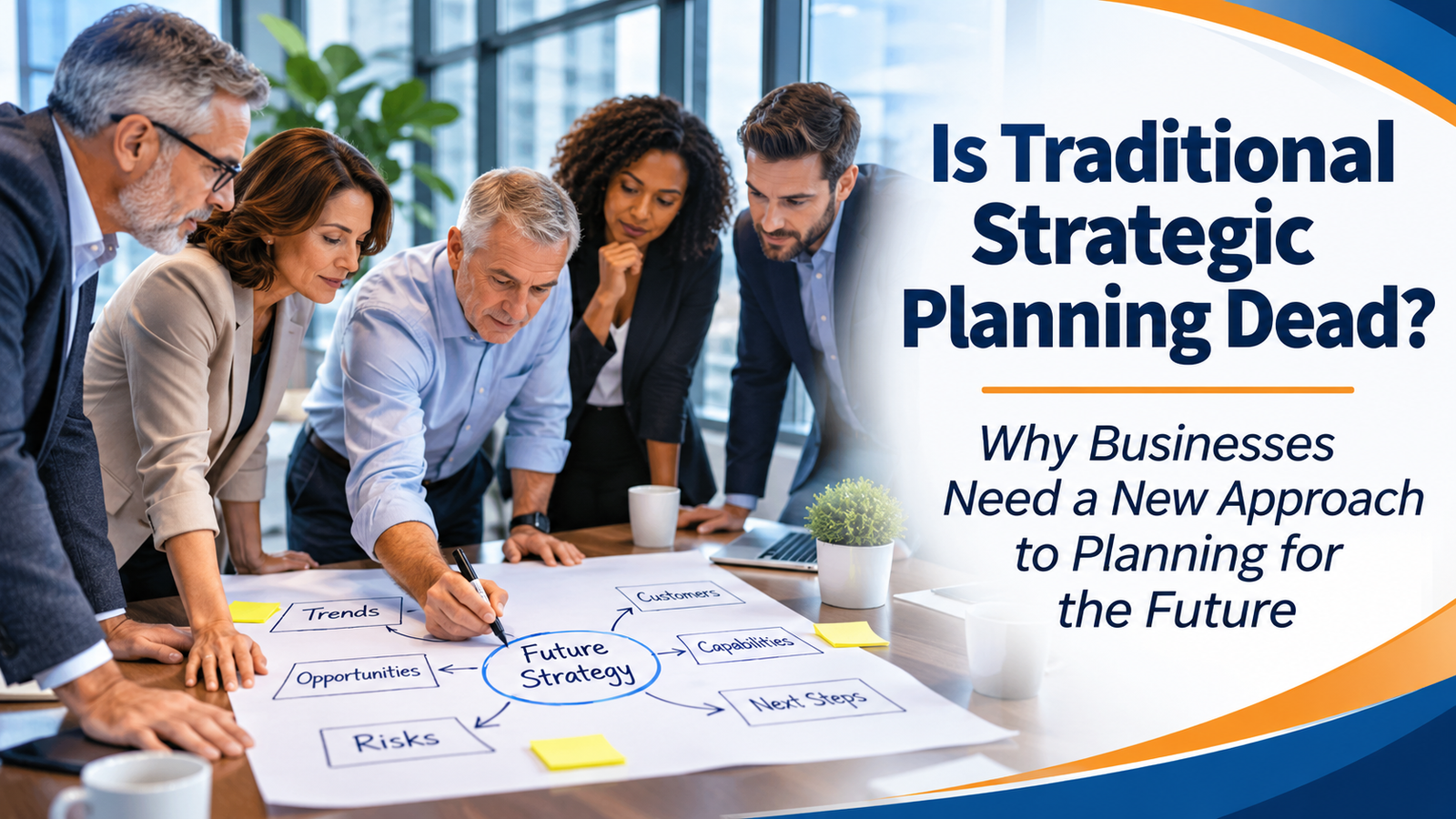
By Jeff Fierstein
Google may offer 12 million definitions of strategic planning. But ask ten people to define it, and you’ll probably get ten different answers!
For our purposes, let’s define formal strategic planning as the process by which an organization determines the strategies it will use to achieve a future goal or set of goals.
Traditionally, this process involves aligning organizational goals with the company’s vision, mission, and values, while analyzing the external environment for opportunities and threats and the internal organization for strengths and weaknesses—the familiar SWOT Analysis.
It’s a logical, structured approach. But there’s a problem: The business environment has changed dramatically, and traditional strategic planning hasn’t kept pace.
The Problem: Strategic Planning Was Designed for a Different Era
When formal strategic planning gained popularity in the 1960s, businesses operated in a relatively stable economic and competitive environment.
The post-World War II decades were characterized by economic growth and prosperity. American businesses enjoyed significant competitive advantages, and international competition was relatively limited. Our innovation dominance allowed many companies to control the pace of change.
Under those conditions, organizations could reasonably establish planning horizons of ten years or more. Reviewing and updating plans quarterly or annually was often sufficient. Businesses had time to implement strategies and adjust when necessary.
That world no longer exists.
During the 1970s, 80s, and 90s, globalization fundamentally changed the competitive landscape. Rapid technological advances disrupted established industries. Competitive positioning became essential not just to maintaining market share, but to survival.
New generations of entrepreneurs entered the marketplace with fresh ideas, innovative business models, and the willingness to move quickly. Smaller, more agile companies increasingly challenged established organizations.
It became the classic problem of trying to turn an aircraft carrier around. By the time a large organization recognized the need to change, analyzed the situation, revised its strategic plan, and implemented the necessary changes, the opportunity—or threat—might already have passed.
COVID-19 Exposed the Weaknesses of Traditional Planning
Then came 2020.
COVID-19 dramatically disrupted the American and global business environment. Businesses of every size faced unprecedented challenges. Supply chains collapsed, customer behaviors changed, markets shifted, and entire industries were forced to reinvent themselves.
For many organizations, the disruption came too quickly for their existing plans to provide meaningful guidance.
Larger companies, often accustomed to formal, long-range strategic planning, faced a particularly difficult challenge. Their size, organizational complexity, and rigid decision-making structures made rapid adaptation difficult.
Some struggled with declining revenues, layoffs, excess inventory, and financial distress. Others discovered that the assumptions underlying their strategic plans were no longer relevant.
The problem wasn’t that these organizations had failed to plan. It was that they had become too dependent on plans that couldn’t change quickly enough.
Traditional strategic planning does include contingency planning, scenario analysis, and risk assessment. These are valuable tools. However, they often rely on identifying and anticipating reasonably foreseeable changes.
A global pandemic demonstrated just how quickly the business environment can change in ways that few organizations anticipate.
The lesson? Having a strategic plan isn’t enough. Businesses need a planning process that allows them to change direction quickly.
Is Formal Strategic Planning Dead?
Perhaps not entirely. Many of its fundamental principles remain valuable.
Organizations still need a clear vision, mission, values and purpose. They need to understand their competitive environment, identify opportunities, recognize threats, and align their resources with organizational goals.
But the traditional model of establishing long-range goals and periodically reviewing a relatively fixed strategic plan is no longer adequate for today’s business environment.
We need a different approach to business planning.
An effective modern planning model should incorporate:
- Less dependence on long-term planning. Recognize that the farther into the future we plan, the greater the uncertainty.
- Greater emphasis on short-term goals. Establish achievable, sequenced goals that can be reassessed and replaced as conditions change.
- A stronger commitment to vision, mission, and purpose. These should provide organizational direction even when specific goals and strategies change.
- Faster adaptation and pivoting. Build the ability to respond quickly to emerging opportunities and changing circumstances.
- Greater emphasis on internal innovation. Don’t rely exclusively on external market opportunities. Encourage employees and leaders to continuously improve products, services, and business processes.
- Continuous environmental monitoring. Regularly assess economic, technological, competitive, social, legislative, and other developments that could affect the organization.
- Flexible organizational structures and talent development. Develop multiskilled employees and organizational capabilities that allow resources to be redirected when necessary.
- Proactive decision-making. Focus on creating the future rather than simply trying to predict it.
Introducing Opportunity Planning: A New Model for Business Planning
Here’s a planning model specifically designed for capturing opportunities for organizational effectiveness and development:
It’s called Opportunity Planning.
Opportunity Planning takes a different approach to the traditional SWOT model by placing the emphasis on the “O”—Opportunity.
Rather than beginning with a front-end, extensive analysis of external threats and internal strengths and weaknesses, organizations identify and select specific opportunities that can become organizational goals.
These opportunities can be external or internal.
External opportunities may arise from:
- Economic and market conditions
- Changes in customer needs
- Competitive developments
- Cost and availability of capital
- Infrastructure and technology
- Talent availability and industry trends
Internal opportunities emerge from innovation, employee contributions, operational improvements, and the development of new products and services.
Of course, vision, mission, values and organizational purpose remain central to the process. Potential environmental threats are also considered, including opportunities to turn those threats into competitive advantages.
Once leaders select their opportunities and establish goals and strategies, the organization assesses its internal capabilities and determines what must change to achieve those goals and strategies.
A customized business canvas helps identify the necessary organizational changes. Those changes are then translated into practical actions and implemented.
The result is a planning process that connects opportunity identification, strategy selection, goal setting, organizational alignment, and execution.
From Strategic Planning to Strategic Management
Perhaps the most important distinction is that Opportunity Planning doesn’t treat planning as an annual or quarterly event.
Strategic management becomes a continuous process.
Organizations continually monitor their environments, identify emerging opportunities, encourage internal innovation, evaluate progress, and adjust their goals and strategies as conditions change.
Opportunity Planning combines the speed and adaptability of agile planning with the structure and discipline of formal strategic planning.
The result is a more flexible, future-oriented approach that allows businesses to respond to change without losing sight of their purpose and direction.
Opportunity Planning is ideal for organizations with the ability to plan fast, execute fast, and adapt quickly – typically with small and mid-sized organizations.
The Bottom Line
We cannot predict every disruption, market shift, technological breakthrough, or economic challenge that lies ahead.
But we can build organizations that are better prepared to respond.
The question is no longer simply whether we have a strategic plan.
The question is whether our planning process gives us the ability to recognize opportunity, make decisions, and change direction before it’s too late.
Let’s stop trying to predict the future and start building organizations capable of creating it.
Plan for opportunity. Prepare for change. Achieve your goals.
Adapted from: Leadership Whack-A-Mole: Actionable Strategies for Leadership Challenges. (c) 2024 Ric Shriver and Jeff Fierstein. To learn more about the book, peruse this website or click on the banner below.

We value your thoughts and experience with this topic. Leave a comment below and let’s start a conversation.
For a complimentary copy of this article, complete the Download this Article box below.
test